
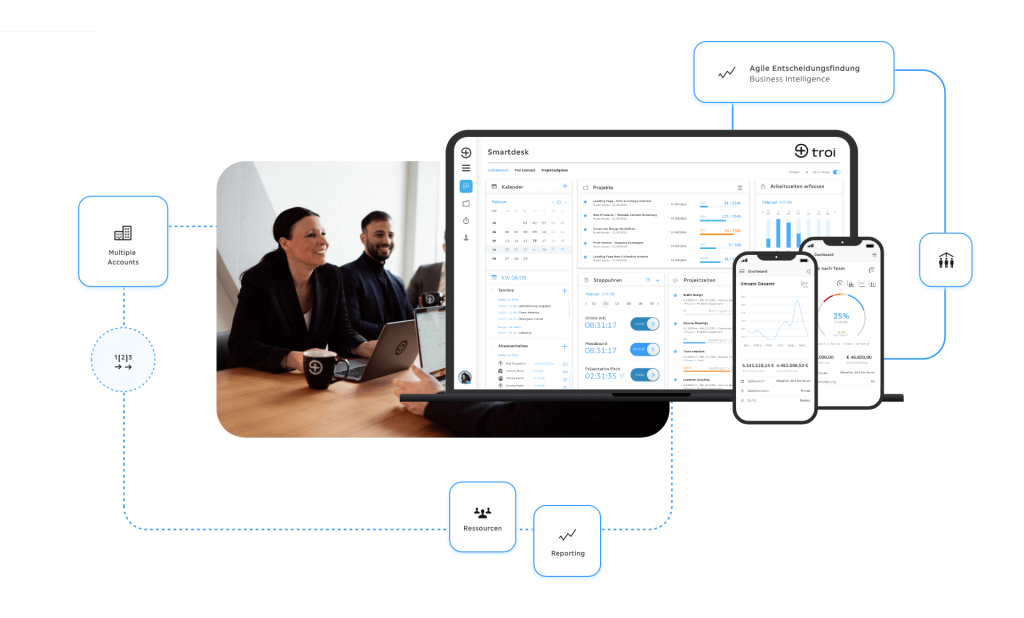
Why ERP Software Is Worth It for Project-Based Companies
Introduction: What Is ERP Software?
ERP stands for Enterprise Resource Planning – the comprehensive planning and management of company resources such as time, budget, staff, materials, and projects.
An ERP system consolidates all essential business processes into one central platform. Instead of using isolated tools or manual Excel sheets, the entire organization becomes digitally connected – from project planning to controlling and invoicing.
For project-based businesses, this is especially valuable, as success depends heavily on transparency, efficiency, and seamless collaboration.
How Can ERP Software Be Used in Service Companies?
In project-driven environments, flexibility, clear communication, and a precise overview of resources and budgets are critical. This is where ERP software provides targeted support. Here are five key advantages:
- Centralized Data Management: All project information – from quotes and time tracking to invoicing – is managed in one place. This saves time, prevents duplicate data entry, and reduces errors.
- Improved Resource Planning: Who is working on what, and when? ERP systems provide transparent scheduling and ensure that capacities are used efficiently.
- Real-Time Controlling: Budgets, workloads, and project progress can be tracked in real time. Deviations are detected early, and corrective actions can be taken immediately.
- Automated Processes: Standard processes such as quote generation, time tracking, or invoicing can be automated – significantly reducing administrative effort.
- Higher Customer Satisfaction: Structured workflows and clean project execution improve service quality – and therefore client satisfaction.
What Features Should ERP Software for Project-Based Companies Include?
Not every ERP system is the same – and not all are suitable for project-oriented businesses. The following features are particularly important:
- Project Management: Detailed project planning with tasks, deadlines, milestones, and dependencies.
- Time Tracking: Simple and fast recording of hours worked – ideally via app, browser, or desktop.
- Resource Management: Clear planning of staff availability and workloads.
- Financial Controlling: Budget planning, forecasts, cost/revenue comparison, and integration with accounting.
- Quoting & Invoicing: Create quotes and invoices directly from project data – with automatic handover to accounting.
- Reporting & Dashboards: Visualized KPIs for quick insights and informed decision-making.
- Collaboration Tools: Internal and external communication tools for task distribution, feedback, or file sharing.
What to Look for When Choosing the Right ERP Solution
Selecting the right ERP solution is a strategic decision. Consider the following key aspects:
- Industry Focus: The software should be tailored to project-based service providers – generic all-in-one solutions often fall short.
- Ease of Use: An intuitive interface encourages team adoption and shortens onboarding time.
- Scalability: The system should grow with your business – even internationally.
- Cloud vs. On-Premise: Cloud solutions offer flexibility and remote access. Data security and IT infrastructure play a vital role in the decision.
- Integrations: Interfaces with existing tools like DATEV, Microsoft 365, or Slack are a big advantage.
The Path to a Successful ERP Implementation
To ensure a sustainable ERP rollout, the following steps are recommended:
- Needs Analysis: Which processes should be covered? Where are the biggest pain points right now?
- Vendor Selection & Demo: Review different solutions and test usability with your team.
- Pilot Phase: Start with a test run in one project team.
- Data Migration & Training: Plan sufficient time for transferring existing data and training your employees.
- Go-Live & Support: After launch, a reliable support partner is crucial for quick issue resolution.
Conclusion: The Key Benefits at a Glance
A modern ERP system is much more than a digital planning tool. It is the central control hub that creates transparency, automates processes, and drives project profitability.
Companies that adopt a professional ERP solution early secure a clear competitive edge in an increasingly dynamic market.
Why Troi Is the Right ERP Solution for Project-Based Companies
Troi ERP was designed specifically for the needs of project-based service providers – from agencies and consultancies to engineering or IT firms.
The platform combines smart project management with comprehensive controlling, intuitive time tracking, and seamless integration into your existing ecosystem.
With over 20 years of experience, a strong industry focus, and a highly specialized team, Troi supports clients not just during implementation but also throughout day-to-day operations.
Our mission: More clarity, efficiency, and success for project-based companies.
Related Posts

AI or Goodbye? Why Your Business Can’t Afford to Ignore Artificial Intelligence
Artificial Intelligence: More Than Just a Buzzword Artificial Intelligence (AI) is no longer science fiction – it’s transforming the [...]
Save Time with Troi Lumos – Up to 80% Faster Navigation
Save up to 80% of Your Time with Troi Lumos Maybe not quite at the speed of light, but [...]
Growth-Oriented Scaling with the Right ERP System
Why ERP Software Is Worth It for Project-Based Companies Introduction: What Is ERP Software? ERP stands for Enterprise Resource [...]